
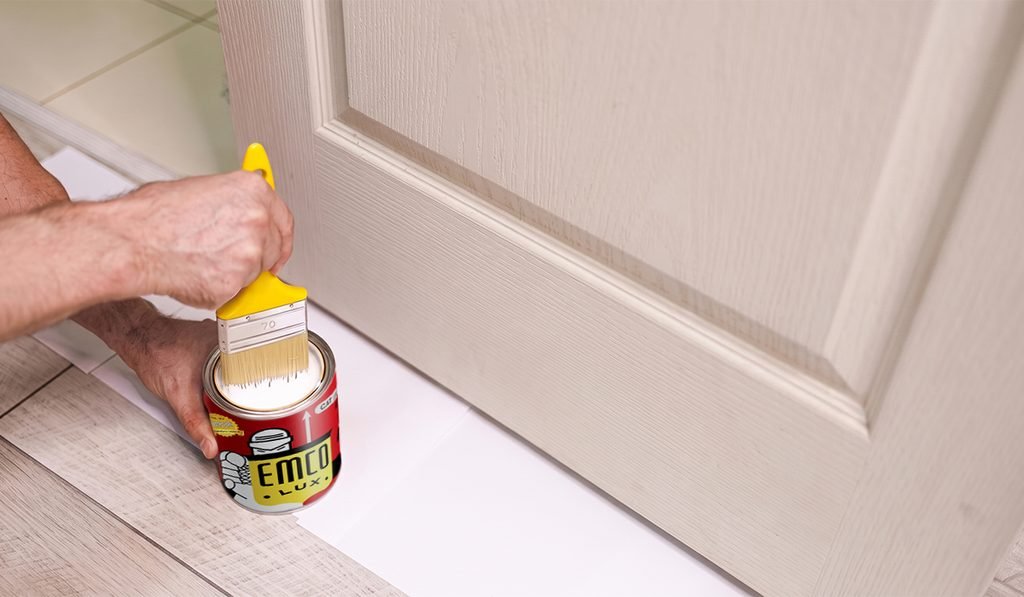
When painting a wooden door, buying paint based on an estimate can lead to an inaccurate number of paint cans set aside for the job. If you buy too much and end up with a lot left over, there’s a risk of waste. While paint can be stored, it may spoil before you’re ready to use it again.
On the other hand, underestimating the amount of paint needed carries the risk of running out in the middle of the job, forcing you to go back to the store to buy more—which means extra time, effort, and transportation costs. This is especially true if you’re hiring a painter: the work gets delayed, but the painter’s daily rate keeps adding up.
A better approach is to first calculate the number of paint cans needed based on the surface area to be painted, the paint’s coverage, and the usage instructions for the paint you’ve chosen. This allows you to choose the most cost-effective paint product based on the total price, rather than being misled by the price per can.
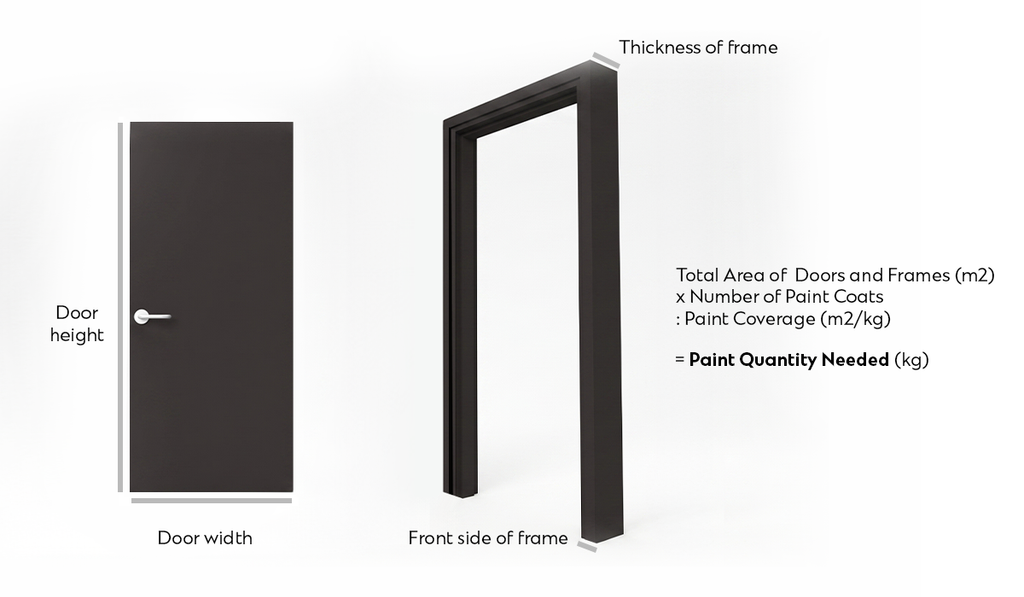
1. First Step: Calculate the Total Area of the Door to Be Painted
First, convert the door’s dimensions to meters.
For example:
Width 90 cm becomes 0,9 meters
Height 210 cm becomes 2,1 meters.
Area of one side of the door:
0,9 m × 2,1 m = 1,89 m²
Since doors are generally painted on both sides:
1,89 m² × 2 sides = 3,78 m² per door
Then multiply that by the number of doors to be painted:
3,78 m² × 3 doors = 11,34 m²
This figure does not include the door frames.
If the door frames are also made of wood and you want to paint them as well, follow these steps.
Calculate the total dimensions of the door frame to be painted.
For example:
Front side: 6 cm
Thickness: 12 cm
Back side = front side: 6 cm
6 cm + 12 cm + 6 cm = 24 cm = 0,24 m
Perimeter of the door frame (left, right, top):
2,1 m + 2,1 m + 0,9 m = 5,1 m
Total area of one door frame:
0,24 m × 5,1 m = 1,22 m²
Then multiply by the number of doors to be painted:
1,22 m² × 3 doors = 3,66 m²
2. Check the Coverage and Instructions for Using the Paint
With a coverage rate of 10–12 m² per kg for EMCO LUX, one 1 kg can can theoretically be used to cover approximately 10–12 m² with a single coat.
Based on the example in No. 1, for 3 doors with a total area of 11,34 m², one 1 kg can of EMCO LUX is sufficient for one coat of paint. The EMCO LUX application system can be used for either one or two coats, as long as the wood or metal surface is completely covered.
EMCO LUX is available in three package sizes:
1 kg with a coverage of 10–12 m²
0,5 kg with a coverage of 5–6 m²
200 ml with a coverage of 2–2.4 m²
So, combine different package sizes according to the total surface area that needs to be painted to minimize paint costs. For example, if the total area is approximately 15 m², you can use one 1 kg can and one 0,5 kg can.
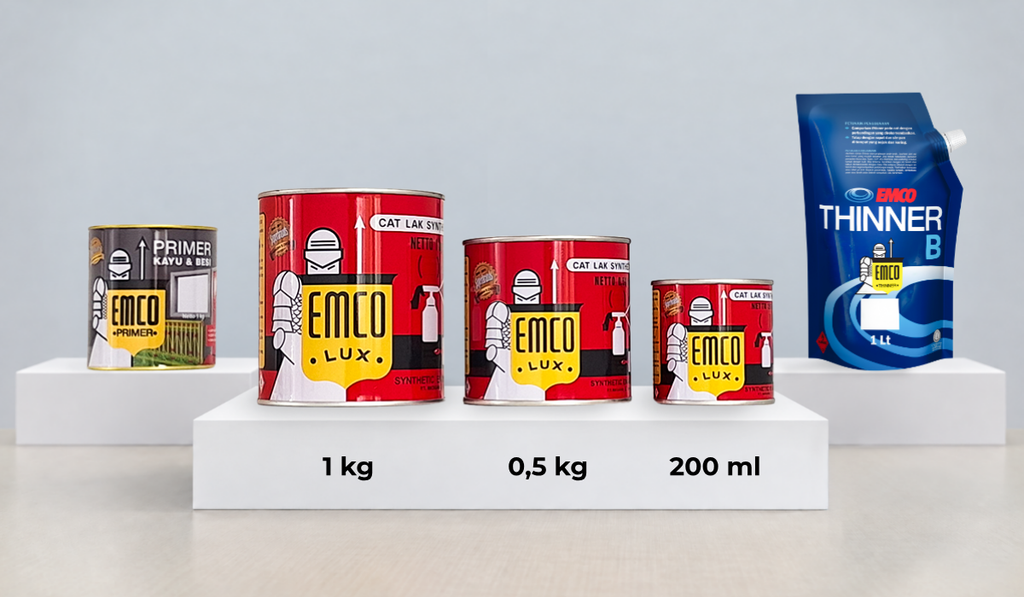
3. Use the EMCO System in Its Entirety
The quality of the paint finish isn’t determined solely by EMCO LUX as the topcoat. The wood surface must be prepared first. After that, apply one coat of EMCO PRIMER as a base coat. The primer helps seal the wood’s pores and provides a surface that’s better prepared for the next coat.
Next, apply 1 coat of EMCO LUX as the finishing layer. For thinning, use EMCO Thinner B according to the recommended application ratios: 5–10% for brush application or 20–25% for spray application. EMCO Thinner B is specially formulated to be the ideal thinner for both EMCO LUX and EMCO PRIMER.
Using the complete EMCO system increases the likelihood that a single coat of topcoat will suffice, eliminating the need to apply up to 2 coats.
That’s how to correctly calculate the amount of paint needed for a wooden door, starting with the surface area to be painted. Next, factor in the product’s coverage rate and the recommended number of coats. Only then can you determine the exact number of paint cans you need to buy.
Now that you understand the correct way to calculate, don’t get caught up in the price per can when trying to determine the most cost-effective paint. Choose the paint with the lowest total purchase price that guarantees high-quality and long-lasting results.
With the complete EMCO PRIMER + EMCO LUX + EMCO Thinner B system, each stage of the painting process uses products specifically designed to perform their intended functions—from surface preparation to the final finish.